 RagineTech
In today’s era of rapid technological advancement, drones have been widely applied in both military and civilian fields. In the military, drones can perform reconnaissance, sorveglianza, and attack missions, providing crucial support for combat operations. And in the civilian sector, drones have demonstrated immeasurable value in aerial photography, logistics delivery, and agricultural plant protection, driving industrial development and improving efficiency.
Tuttavia, the widespread use of drones has also brought negative impacts. Uncontrolled “black flights” E “reckless flights” are increasingly rampant, posing numerous potential threats to public safety. While ordinary drones can play a positive role under regulated management, bassa quota, velocità lenta, and small drones, due to their inherent characteristics, present greater challenges to safety and prevention.
Faced with this increasingly complex, dispersed, and low-cost aerial threat, traditional defense methods are proving inadequate. Perciò, developing an anti-UAV defense system that can provide efficient response and comprehensive coverage has become an urgent priority for protecting critical infrastructure and important assets.
Characteristics of Low-Altitude, Slow-Speed, Small Drones
Low-altitude, velocità lenta, small drones fly at very low altitudes, primarily below 1000 metri, making them highly susceptible to interference from terrain, buildings, trees, and other objects. These objects block signals, increasing the difficulty of detection.
Their radar cross-sections are very small; common multi-rotor drones are tiny, with radar cross-sections of only a few square centimeters or even smaller, making them difficult for traditional radar to detect at long distances.
Their signal systems are diverse, employing communication methods such as Wi-Fi, Bluetooth, data radio, as well as GPS and BDS (BeiDou Navigation Satellite System). Some even use encrypted signals, increasing the difficulty of signal identification and jamming.
The rapid climb rate of small multi-rotor drones allows them to ascend from the ground to tens of meters in seconds, quickly reaching the target area and shortening the reaction time of defense systems.
Their high maneuverability allows them to perform complex maneuvers such as hovering, girando, and diving, enabling them to move freely in confined spaces and evade detection and attack.
Inoltre, their relatively low cost, including manufacturing, R&D, operazione, maintenance, and training costs, makes them accessible to a wider range of users, thus increasing management complexity.
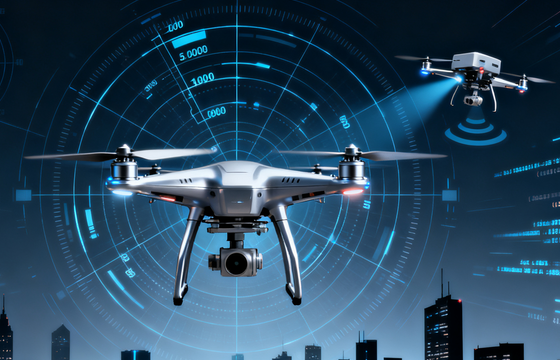
Small drone device
Security Threats to Critical Areas
In the military and defense sectors, bassa quota, velocità lenta, small drones, with their stealth, maneuverability, and low cost, have become a significant security threat.
They can silently approach strategic locations such as military bases and command centers to conduct reconnaissance and surveillance missions, acquiring classified information such as the layout of military facilities, the location of weapons and equipment, and personnel activity patterns.
More seriously, drones can be modified into offensive weapons, carrying improvised explosive devices or small missiles, flying at low altitudes and speeds to evade traditional air defense systems and launch surprise attacks on military targets, causing significant damage and posing a major challenge to military defense.
In high-value civilian security areas, the illegal intrusion of low-altitude, velocità lenta, small drones poses a significant threat. Per esempio, drones have intruded into airport airspace protection zones, causing delays and cancellations of multiple flights and resulting in substantial economic losses; drones have also illegally approached nuclear facilities, posing a potential risk to nuclear safety. Perciò, it is urgent to build an efficient anti-drone defense system for key locations.
Typical Incidents of Drones Causing Global Public Safety Problems
Two drones carrying explosives detonated during a speech by Venezuelan President Maduro, injuring seven people. This was the world’s first reported “political assassination” using drones.
Attacks on Iranian nuclear facilities: Israel was accused of using suicide drones to destroy the power system at Iran’s Natanz nuclear facility;
Attacks on Saudi Aramco oil facilities: Yemen’s Houthi rebels used 18 drones and seven cruise missiles to attack Saudi oil facilities, causing global oil prices to surge.
Illegal drone intrusions have occurred at the White House in the United States, the Prime Minister’s official residence in Japan, the presidential residence in France, the Blue House in South Korea, the Kremlin in Russia, and the South China Sea.
Based on these security incidents, to address the problem of low-speed, small drones illegally intruding into high-value defense and civilian security areas, it is imperative to take strong measures, improve technological means, and utilize technologies such as radar, photoelectric detection, and artificial intelligence to build a comprehensive, multi-layered drone monitoring and countermeasure system to achieve real-time monitoring and effective intervention of drone activities.
Multi-Dimensional Analysis of Counter-Drone Technology
In the modern low-altitude security environment, the miniaturization, cost reduction, and intelligence of drones make traditional single-countermeasure methods insufficient to cover diverse threat scenarios. Perciò, the counter-drone technology system is evolving from “single-point response” A “multi-dimensional collaboration,” forming a comprehensive application pattern encompassing multiple technical routes such as reconnaissance and detection, communication suppression, and navigation deception.
These technologies are both independent and complementary in actual missions, jointly constructing a stable and reliable low-altitude defense system. And the following content will analyze its principles, advantages, and applicable scenarios item by item from the core technology dimension.
Reconnaissance and Detection Technology
Reconnaissance and detection are core elements of counter-drone operations. Overcoming challenges such as low-altitude clutter, weak signals, and small target detection is crucial. Currently, key detection technologies include radar detection, electro-optical detection, acoustic detection, and radio detection.
Radar Detection
Traditional radars have limited detection capabilities against low-altitude, slow-moving small drones. High-resolution, low-sidelobe radars, such as phased array radars and millimeter-wave radars, are advantageous. Multi-radar networking can also improve detection probability and positioning accuracy. In modern radar systems, small unmanned aerial vehicles (UAV) are typical “low-profile, lento, and small” obiettivi. In complex combat environments, radar systems not only need to achieve stable detection and tracking, but also need to effectively identify small UAV targets.
Optoelectronic Detection
Optoelectronic detection equipment includes infrared thermal imagers and visible light cameras. Its working principle is to detect the infrared radiation or visible light signals of a target. Optoelectronic detection equipment offers high resolution and accuracy, enabling real-time tracking and monitoring of drones.
Hensoldt’s Spotter dual-band infrared system integrates thermal imaging and a visible light camera, with a detection range of up to 5 chilometri. Guide Infrared showcased its numerous technological achievements and product applications in the field of infrared thermal imaging at the 20th China Optics Valley International Optoelectronic Exposition.
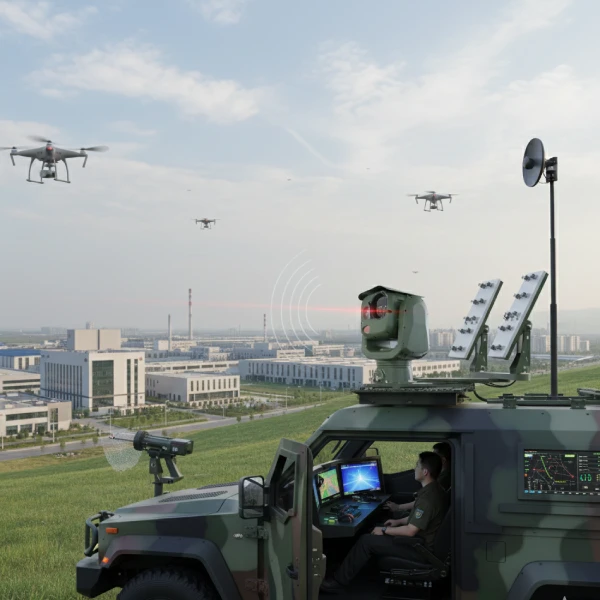
Rilevazione acustica
Acoustic detection technology utilizes the noise characteristics generated during the flight of UAVs to identify and locate targets. It has advantages such as passive detection, strong concealment, and resistance to electromagnetic interference, making it suitable for complex electromagnetic environments or sensitive urban areas.
IL “acoustic radar” developed by MIT Lincoln Laboratory based on a 64-channel microphone array can detect small quadcopter UAVs within a 1-kilometer range with a false alarm rate of less than 0.1 times/hour. Acoustic detection technology can be used to locate UAVs and prevent malicious attacks by UAVs.
Radio Detection
Radio detection equipment detects targets by detecting the communication and navigation signals of UAVs, and has high sensitivity and high accuracy. The AUDS system of Blighter Surveillance Systems in the UK scans the 2.4 GHz/5.8 GHz frequency band to locate the remote control signals of UAVs.
Communication Suppression Technology
Communication suppression aims to disrupt communication between the UAV and its control station and navigation system. Common methods include radio frequency (RF) jamming and GPS jamming. RF jamming suppresses the UAV’s communication link by transmitting jamming signals at the same or similar frequencies as the UAV’s communication signals. GPS jamming interferes with the UAV’s satellite navigation system, preventing it from obtaining accurate position information and causing it to lose control.
Raytheon’s “Tempest” digital RF storage technology can enhance jamming signals and improve suppression efficiency by 6 volte.
China’s “Skynet” series of vehicle-mounted jamming systems supports frequency-hopping jamming and proposes a UAV communication security protection method combining frequency-hopping technology and chaotic mapping to address the shortcomings of existing lightweight authentication mechanisms in effectively resisting jamming attacks.
Navigation Spoofing Technology
Navigation spoofing technology causes UAVs to deviate from their intended flight path by sending false navigation signals. The navigation spoofing devices simulate satellite navigation system signals, sending false position and speed information.
Per esempio, the US HENSOLDT Nav Guard system can generate false GPS signals.
China’s BeiDou deception technology can achieve coordinated deception of BeiDou-3 B1C/B2a dual-frequency points and is better adaptable to multiple satellite navigation systems, achieving a deception success rate of over 95%.
Small unmanned aerial vehicles (UAV) heavily rely on GPS for navigation but are vulnerable to GPS spoofing attacks—commercial simulators use forged signals to cause UAVs to deviate from their flight paths. While many anti-spoofing detection methods exist, most require additional hardware and are not suitable for small UAVs with limited payloads. Perciò, navigation deception technology is an effective counter-UAV strategy.
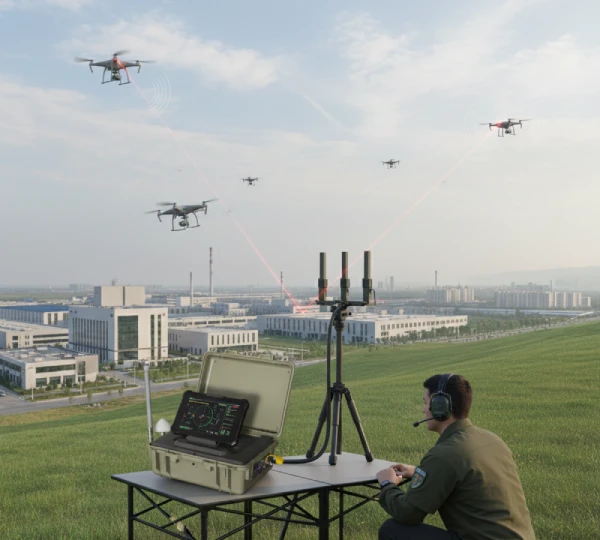
Physical Damage Technology
Physical damage refers to directly inflicting hard-kill damage on drones, rendering them incapable of flight. Common methods include laser weapons, microwave weapons, and net guns. Laser weapons fire high-energy laser beams to heat and melt the drone’s structure; microwave weapons fire high-power microwaves to damage the drone’s electronic equipment; net guns fire nets to capture the drone.
Lockheed Martin’s ATHENA system, equipped with a 30-kilowatt fiber laser, can shoot down a drone 1.6 kilometers away in 5 secondi. The United States leads in high-power microwave anti-drone technology due to its advantages in high-power microwave light-speed attacks and area-effect damage. Tuttavia, microwave weapons suffer from practical problems such as large system size, limited mobility, limited range, severe power attenuation, indiscriminate killing, and the risk of friendly fire damage.
Integrated Drone Countermeasures
Integrated countermeasures combine multiple anti-drone methods to construct a layered interception network. Gli Stati Uniti. Joint Anti-Drone Systems Office has proposed a three-layer architecture of “detection-identification-interception.” IL 2022 Beijing Winter Olympics utilized the “Low Altitude Guardian” laser system, combined with a drone management platform, to achieve all-weather, all-around monitoring of the competition area, garantire la sicurezza dei Giochi.
Sulla base dell’analisi delle contromisure esistenti, il concetto di difesa di “combinando hardware e software, difesa a strati, e intercettazione e logoramento multilivello” costruisce efficacemente un sistema offensivo e difensivo integrato. Questo sistema risolve efficacemente i problemi di insufficienza delle singole contromisure e di scarsa efficacia difensiva, fornire un riferimento per la costruzione dei futuri sistemi di difesa.
Conclusione
Con la continua innovazione della tecnologia dei droni, la minaccia rappresentata dalla bassa quota, velocità lenta, e piccoli droni per la sicurezza dei luoghi critici sta diventando sempre più complessa e grave.
Attraverso una ricerca approfondita su vari metodi anti-drone, questo articolo costruisce un sistema di difesa anti-drone per posizioni critiche, fornire una soluzione completa per affrontare questa minaccia.
Nelle applicazioni pratiche, è necessario selezionare in modo flessibile metodi anti-droni e strategie di difesa in base alle esigenze di sicurezza delle diverse posizioni critiche e alle caratteristiche delle minacce dei droni, e ottimizzare continuamente il sistema di difesa.
Contemporaneamente, è essenziale aumentare continuamente gli investimenti nella ricerca e nello sviluppo della tecnologia antidrone, incoraggiare l’innovazione, rafforzare la cooperazione interdisciplinare, e promuovere lo sviluppo intelligente ed efficiente dei sistemi di difesa anti-UAV.