Unmanned aerial vehicles (UAVs) have rapidly evolved from consumer devices into potential security threats. For airports, military bases, 에너지 시설, and major public venues, building a multi-layered anti-drone defense system (C-UAS) has become a critical component of modern security architecture. This article provides a complete technical overview of three-layer drone defense architecture, operational measures within each defense zone, enabling technologies such as AI and multi-sensor fusion, and future development trends of C-UAS systems.
Scientific Deployment of Multi-Layer C-UAS Defense Zones
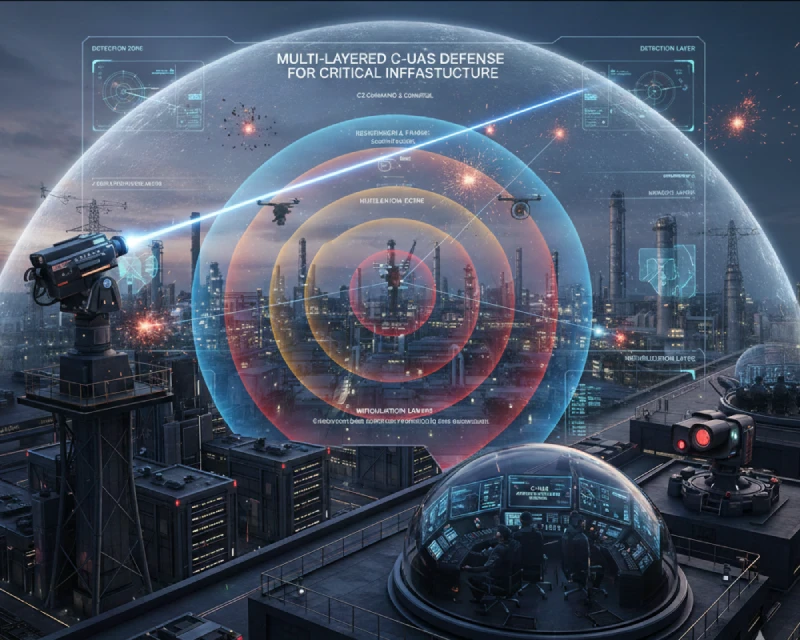
Based on the security needs of key areas and the threat level of drones, the anti-drone defense system for key areas is divided into a warning zone, a defense zone, and a core zone.
Warning Zone — Early Detection Layer
The warning zone is the first line of defense for key locations, situated within a radius of several kilometers to tens of kilometers around the key location. Taking an airport as an example, the warning zone, as the first line of defense against drones, is typically located within a radius of 5 에게 30 kilometers around the airport. The determination of this range depends on factors such as the airport’s size, the surrounding environment, and the distribution of past drone threat incidents. This area should be equipped with various reconnaissance and detection equipment, such as radar, electro-optical detection equipment, and acoustic detection equipment, forming a tight monitoring network.
Once a drone is detected, these devices will quickly transmit target information to the command center. The command center formulates response strategies based on the target type and threat level, continuously monitors low-threat drones, and notifies the warning zone to prepare for the interception of high-threat drones.
Defense Zone — Interception and Engagement Layer
The defense zone is located within the warning zone, extending from hundreds of meters to several kilometers around the key location. It is the key area for intercepting and engaging drones. Various counter-drone equipment is deployed here, including communication suppression equipment, navigation decoys, and physical disruption devices. When a drone breaches the warning zone and enters the defense zone, reconnaissance and detection equipment transmits target information in real time.
The counter-drone equipment selects appropriate countermeasures based on the type and characteristics of the drone; for example, communication suppression or navigation decoys are used against small civilian drones, while physical disruption devices are employed against offensive drones.
Core Zone — Last-Line Protection of Critical Assets
The core zone is the last line of defense for critical locations, located within hundreds of meters of the main zone, directly protecting important facilities and personnel. The core zone is equipped with high-precision reconnaissance and detection equipment and advanced counter-drone equipment, such as high-power laser weapons and smart interceptor missiles. Once a drone enters the core zone, the equipment will react rapidly and conduct precise strikes to ensure the threat is eliminated in the shortest possible time. The core zone relies on trained personnel and predefined contingency procedures to ensure 100% response reliability.
Counter-Drone Measures Across Different Defense Layers
It is evident that effectively addressing drone threats in the security defense of important targets (such as the defense of important wartime locations) has become an urgent problem to be solved. This article elaborates on the countermeasures for different types of drones in the warning zone, defense zone, and core zone, providing strong practical guidance.
Early Warning Zone Reconnaissance
The early warning zone primarily relies on reconnaissance and detection methods. Radar conducts wide-area airspace scans to acquire information such as the distance, azimuth, altitude, and speed of drones; electro-optical detection equipment accurately identifies drones and determines their type; acoustic detection equipment serves as an auxiliary means to detect drone tracks in low-altitude areas. To avoid interfering with surrounding normal communication and navigation equipment, communication suppression and navigation deception are generally not used in this area.
Defense Zone Monitoring and Interception
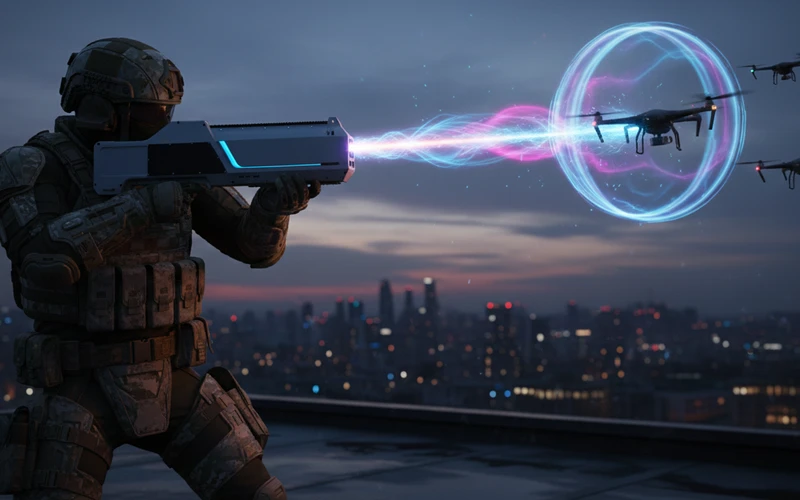
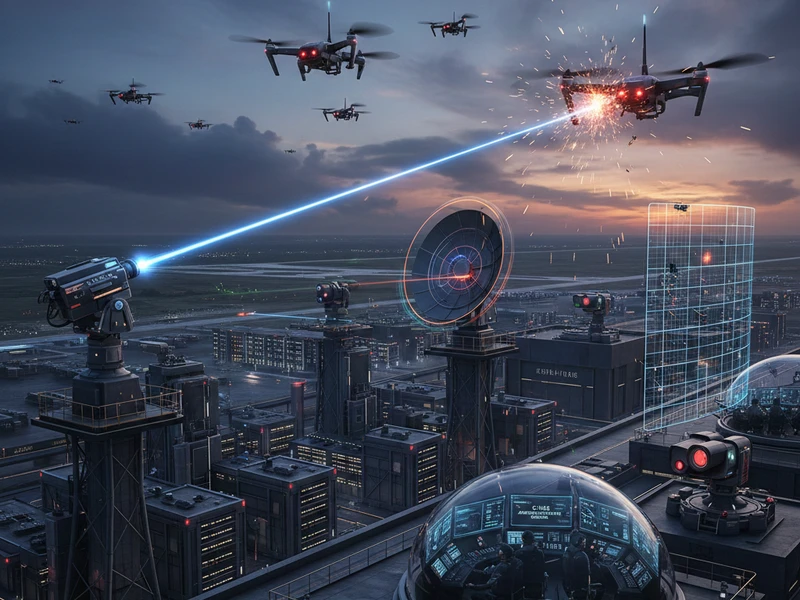
Reconnaissance and detection equipment within the defense zone continuously monitors drones and flexibly selects countermeasures based on the drone type. For small civilian drones, communication suppression or navigation deception can both prevent their illegal approach and reduce damage to the drones themselves; for offensive drones, physical destruction methods such as laser weapons and microwave weapons can quickly destroy targets, ensuring the security of key locations. Various anti-drone methods should cooperate to form an organic whole.
Core Zone Counterattack
The defense of the core area is crucial. High-precision reconnaissance and detection equipment can quickly detect and lock onto incoming drones, providing accurate target information for anti-drone equipment. Advanced equipment such as laser weapons and net guns are ready to be deployed immediately upon detecting a drone, quickly destroying or capturing the target. Meanwhile, core area defense relies on specialized personnel and comprehensive contingency plans to ensure foolproof responses to various drone threats.
Coordinated Operation of a Multi-Layered Defense System
The anti-drone defense system in key areas is a complex systems engineering project. Close coordination between different areas and anti-drone measures is crucial for effective defense. Countries are actively researching anti-drone swarm defense strategies, primarily focusing on operational concepts, operational procedures, and new air defense systems.
A robust communication system and a unified command and control system are essential for achieving real-time information transmission and rational resource allocation, thereby improving the coordination efficiency of the defense system.
After detecting a drone, reconnaissance and detection equipment within the early warning zone transmits detailed information to the command center. The command center comprehensively analyzes the target threat level and issues interception orders to the defense zone.
The defense zone selects appropriate measures based on the orders and the characteristics of the drone. If a drone breaches the defense zone and enters the core area, the reconnaissance and detection equipment in the core area will immediately react, guiding anti-drone equipment for a final defensive attack.
In this process, a robust communication system ensures timely and accurate information transmission, while a unified command and control system rationally allocates resources, coordinates actions across different areas and equipment, improves the operational efficiency of the defense system, and effectively counters the threat of unmanned aerial vehicles (UAVs).

Diagram of a multi-layer Counter-UAS (C-UAS) defense system protecting a restricted area.
Key Technologies Enabling Modern Counter-UAV Systems
Artificial Intelligence (AI) for Recognition & Decision-Making
Artificial intelligence (AI) technology is a core component. Target recognition and classification algorithms based on deep learning can improve the accuracy and speed of identifying low-altitude, slow-moving, and small UAVs. Even in complex backgrounds and under various interference conditions, it can accurately distinguish between legitimate and illegal UAVs and predict their flight intentions, providing a basis for subsequent countermeasure decisions. Simultaneously, the intelligent decision-making system utilizes AI to analyze massive amounts of reconnaissance data and automatically generate optimal countermeasure strategies, improving decision-making efficiency and scientific rigor.
5G for Low-Latency C-UAS Networking
5G communication technology is also crucial. Its high bandwidth and low latency characteristics ensure high-speed and stable data transmission between devices within the counter-UAV defense system. This allows information acquired by reconnaissance and detection equipment to be transmitted to other devices in real time and accurately, achieving information sharing and ensuring smooth collaboration between different domains and countermeasures, thereby improving the overall defense response speed.
Multi-Sensor Fusion Technology
Multi-technology integration and innovation are indispensable. Deeply integrating radar, optoelectronic, and acoustic reconnaissance and detection technologies to form complementary advantages can enhance UAV detection performance. For example, leveraging the long-range detection advantage of radar and the high-precision identification advantage of optoelectronic detection can achieve comprehensive, multi-layered detection of UAVs. Based on the different states and threat levels of UAVs, the optimal countermeasures can be automatically selected, thereby improving the effectiveness of countermeasures.
Future Trends of Anti-UAV Defense Systems
In the future, anti-UAV defense systems in key areas will exhibit trends towards intelligence, integration, and networking. The level of intelligence will be further enhanced, with artificial intelligence technology permeating the entire defense system, achieving full-process intelligence from UAV detection, 신분증, and tracking to countermeasure decision-making and effectiveness evaluation. Intelligent defense systems can autonomously learn and adapt to constantly changing UAV threats, automatically optimizing defense strategies and improving defense efficiency and accuracy. Future anti-UAV technology and defense systems will exhibit the following development trends:
AI-Driven Full-Process Automation
Artificial intelligence technology will be deeply integrated into the anti-UAV field. Target recognition algorithms based on deep learning will further improve the accuracy and speed of identifying low-altitude, slow-speed, and small UAVs, quickly distinguishing between normally flying UAVs and illegally intruding UAVs, and even predicting their intentions. During the decision-making and command phases, intelligent decision-making systems can analyze massive amounts of reconnaissance data in real time and automatically generate optimal countermeasures.
Distributed Network Defense Nodes
Networked development will endow defense systems with greater scalability and adaptability. By constructing distributed network defense nodes, the coverage and monitoring range around key locations can be expanded. These nodes can be flexibly deployed and adjusted as needed to form a dynamic defense network, effectively addressing various threats posed by drones. Simultaneously, by utilizing cloud computing and edge computing technologies, computing resources can be rationally allocated to each node, improving system efficiency and response speed.

New Materials & High-Energy Technologies
As new materials and energy technologies advance, anti-drone equipment will become lighter, smaller, and more energy-dense. For example, new-material laser devices will offer higher power density in a more compact form, improving deployment efficiency, while next-generation batteries and miniaturized power sources will provide longer-lasting energy support.
International Cooperation Trends
International cooperation will become increasingly important in the field of anti-drone warfare. As drone threats globalize, countries will increase cooperation in technology R&D, intelligence sharing, and standards development. Through such collaboration, nations can jointly counter cross-border drone threats, advance global anti-drone technology, and strengthen our collective ability to address UAV security challenges.
Conclusion
As UAV technology continues to evolve, multi-layer anti-drone defense systems will play an increasingly vital role in safeguarding critical infrastructure and national security. In the future, anti-drone defense systems in key areas will be continuously improved, building a solid security defense line for key military and defense targets and high-value civilian security areas, ensuring national security and social stability, and creating a safe and stable environment for economic and social development.
Frenquently Asked Questions
An Anti-Drone Defense System (C-UAS) is an integrated security solution designed to detect, 식별하다, 길, and neutralize unauthorized drones. It typically combines radar, EO/IR sensors, RF scanners, and countermeasures to protect airports, 에너지 시설, military bases, government institutions, and large commercial sites.
The three-layer architecture delivers multi-layered, in-depth protection:
- Warning Zone: Long-range early detection
- Defense Zone: Primary interception and countermeasure area
- Core Zone: Final protective shield for critical assets
This structure significantly increases detection accuracy, reduces false alarms, and improves interception success rates.
예. Modern C-UAS systems supported by AI algorithms, 5G networking, and multi-sensor fusion can:
- Track multiple UAVs simultaneously
- Prioritize threats automatically
- Assign countermeasures in real time
- Maintain high interception performance under heavy drone density
Swarm defense capability is a critical development trend.
High-risk sectors include:
- International airports and transportation hubs
- Energy infrastructure (oil & gas, power plants, wind farms)
- Prisons and law enforcement facilities
- Government buildings and public events
- Military bases and border security sites
- Technology campuses and confidential industrial zones
Demand from B2B enterprises and security agencies continues to grow.
Today’s C-UAS systems achieve a high degree of automation, including:
Automatic detection and classification
Real-time threat assessment
Automated countermeasure recommendations
Automatic event recording and reporting
However, many countries require human confirmation for critical countermeasures to ensure compliance with safety and regulatory standards.
When deployed under regulated conditions, high-energy lasers include:
- Pre-defined safe firing angles
- Automatic target identification
- Environmental monitoring (wind, humidity, refraction)
- Strict safety thresholds
These systems are designed to neutralize UAVs while ensuring the safety of nearby personnel and infrastructure.
라진테크