라진 테크놀로지, 우리는 안티 드론 장비에 중점을 두고 있습니다 개발 생산, 저고도 공역을 더욱 안전하게 만들기.

이메일: 마케팅@hzragine.com |

무역 뉴스

Anti Drone Gun for Critical Infrastructure Protection | Buyer’s Guide

Anti Drone Gun for Critical Infrastructure Protection: What Buyers Need to Know Before Procurement

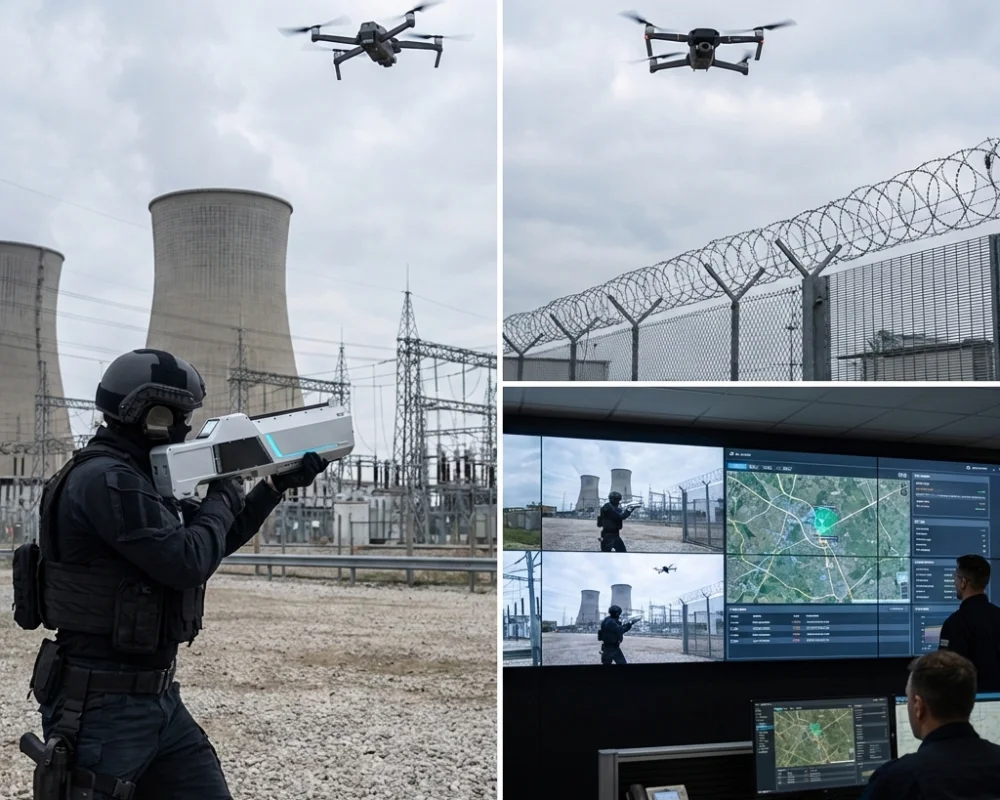
Unmanned aerial vehicles are no longer limited to recreational or commercial use. In recent years, unauthorized and malicious drones have emerged as a serious threat to critical infrastructure, including power plants, 공항, oil and gas facilities, data centers, ports, and government buildings.

For organizations responsible for protecting these high-value assets, the question is no longer if counter-drone capability is required—but which solution delivers reliable protection, legal compliance, and operational efficiency.

Among available counter-UAS technologies, the anti drone gun has become a preferred option for many professional users due to its mobility, precision, and immediate response capability. However, procurement decisions require more than surface-level understanding.

This guide explains what buyers must evaluate before procuring an anti drone gun for critical infrastructure protection, helping decision-makers avoid costly mistakes and select solutions that perform in real-world environments.

Why Critical Infrastructure Is a Prime Target for Drone Threats

Critical infrastructure sites present unique risk profiles:

  • Large physical footprints and open perimeters

  • High-value or hazardous assets

  • Continuous operations with zero tolerance for disruption

  • Strict regulatory and safety requirements

Unauthorized drones can be used for surveillance, 밀수, signal interference, or physical attacks, creating operational downtime, safety hazards, and reputational damage.

Traditional security measures—fencing, cameras, radar, and patrols—were not designed to detect or neutralize low-altitude, slow-moving aerial threats. This gap has driven growing adoption of anti drone gun systems as part of layered defense strategies.

What Is an Anti Drone Gun and How Does It Work?

An anti drone gun is a portable, directional counter-drone device designed to disrupt a drone’s communication and navigation systems using targeted electromagnetic interference.

Unlike wide-area jamming systems, an anti drone gun allows operators to:

  • Visually identify a threat

  • Aim at a specific drone

  • Neutralize it with controlled RF interference

Typical disruption methods include:

  • Control link jamming (disconnects drone from operator)

  • GNSS/GPS interference (forces hover, landing, or return)

  • Multi-band coverage for commercial and modified drones

This controlled approach is particularly valuable in critical infrastructure environments, where precision and safety are essential.

Key Advantages of Using an Anti Drone Gun for Critical Infrastructure

1. Precision Engagement in Sensitive Environments

Critical infrastructure sites often operate near populated areas, aircraft corridors, or other RF-sensitive systems. An anti drone gun provides directional and limited-area interference, reducing the risk of collateral impact on authorized communications.

2. Rapid Response Without Fixed Installation

Unlike fixed jammers or kinetic systems, anti drone guns:

  • Require no permanent infrastructure

  • Can be deployed immediately by trained personnel

  • Are suitable for temporary or evolving threat scenarios

This makes them ideal for power substations, mobile command units, ports, and remote facilities.

3. Cost-Effective Counter-Drone Capability

From a procurement perspective, an anti drone gun typically offers:

  • Lower upfront investment compared to integrated C-UAS platforms

  • Minimal installation costs

  • Reduced maintenance requirements

For organizations seeking high ROI without overengineering their defense system, this is a critical advantage.

Critical Technical Factors Buyers Must Evaluate

Not all anti drone gun solutions are equal. Before procurement, buyers should evaluate the following criteria carefully:

Frequency Coverage

Ensure the anti drone gun supports multi-band frequencies, commonly including:

  • ISM bands (2.4 GHz, 5.8 GHz)

  • GNSS bands (GPS, GLONASS, Galileo, BeiDou)

  • Optional extended bands for customized drones

Limited frequency coverage may leave gaps exploitable by modified UAVs.

Effective Range and Directionality

For critical infrastructure, effective engagement distance is essential. Buyers should assess:

  • Maximum operational range under real-world conditions

  • Beam width and targeting precision

  • Performance in high-interference environments

Manufacturer claims should be validated with field-tested data, not laboratory figures alone. For critical infrastructure protection, buyers should prioritize full-frequency coverage, enabling detection and neutralization of both commercial and modified drones operating across WiFi, cellular, and GNSS bands.

Power Management and Endurance

Operational continuity matters. Key questions include:

  • Battery life under continuous use

  • Hot-swappable battery options

  • Charging time and logistics support

In emergency scenarios, equipment downtime is unacceptable.

Ergonomics and Operator Training

Security personnel may need to deploy the device under stress. A professional anti drone gun should feature:

  • Balanced weight and ergonomic design

  • Intuitive user interface

  • Minimal training requirements

Ease of use directly impacts response speed and effectiveness.

Legal and Regulatory Considerations

One of the most overlooked aspects of anti drone gun procurement is legality status and regulatory compliance.

RF jamming technologies are subject to strict controls in many jurisdictions. Buyers must ensure:

  • The solution complies with local spectrum regulations

  • Deployment is restricted to authorized entities

  • Usage protocols are clearly documented

For government agencies and infrastructure operators, working with experienced suppliers who understand export controls and regulatory frameworks is essential.

Integration into a Layered Counter-Drone Strategy

While effective on its own, an anti drone gun performs best as part of a layered defense architecture, working alongside:

  • Drone detection sensors (RF scanners, radar, EO/IR)

  • Command and control platforms

  • Physical security and access control systems

In this role, the anti drone jammer becomes the last-line neutralization tool, enabling precise response after detection and identification.

What Professional Buyers Look for in a Supplier

Beyond technical specifications, procurement teams should assess the trustworthy supplier based on:

  • Proven experience in critical infrastructure projects

  • Ability to support customization and frequency adaptation

  • Technical documentation and after-sales support

  • Export experience and compliance capability

For B2B buyers, supplier reliability is as important as product performance.

Final Thoughts: Making an Informed Anti Drone Gun Procurement Decision

Protecting critical infrastructure against drone threats requires practical, compliant, and scalable solutions. The anti drone gun has earned its place as a trusted tool for professional users—but only when selected with a clear understanding of operational requirements and risk environments.

By evaluating technical performance, regulatory compliance, integration capability, and supplier credibility, buyers can ensure their investment delivers real-world protection—not just theoretical capability.

10 Frequently Asked Questions

An anti drone gun is a portable counter-UAS device designed to disrupt unauthorized drones by interfering with their communication and navigation signals, forcing the drone to land, hover, or return to its take-off point.

예. Most professional anti drone guns are designed to counter common commercial drones as well as modified UAVs, depending on their frequency coverage and output power.

An anti drone gun usually covers common control and navigation frequencies such as 2.4G, 5.2 G, 5.8 G, WiFi bands, GNSS/GPS bands, and in some cases cellular communication bands, depending on the model and configuration.

The effective range varies based on device power, antenna design, environmental conditions, and interference levels, typically 1-2km. Real-world operational range is often shorter than laboratory test data.

The legality of using an anti drone device depends on local regulations related to radio frequency interference and counter-drone operations. These devices are typically restricted to authorized entities such as government agencies and critical infrastructure operators.

An anti drone gun is a directional, portable device used for targeted drone neutralization, while a drone jammer system is often fixed or vehicle-mounted and designed for broader area coverage.

예. Anti drone guns are commonly used as a response or neutralization layer within a layered counter-drone defense system that includes detection, tracking, and command components.

Anti drone guns are commonly used by government agencies, military units, law enforcement, critical infrastructure operators, and professional security service providers.

Most anti drone guns are designed for field use, featuring handheld or shoulder-fired form factors, battery-powered operation, and rapid deployment capability for mobile security teams.

Buyers should evaluate frequency coverage, operational range, compliance with regulations, ease of use, durability, and compatibility with existing counter-drone systems before making a procurement decision.

이전:

답장을 남겨주세요

이 사이트는 스팸을 줄이기 위해 Akismet을 사용합니다.. 댓글 데이터가 처리되는 방법 알아보기.

메시지를 남겨주세요