 라진테크
라진테크
When Unauthorized Drone Flights Become a Hazard, the Anti-Drone Industry Needs “Sharp Eyes”
오늘, drones have evolved from professional equipment to everyday tools, used in logistics delivery, film shooting, agricultural spraying, 그리고 더. 하지만, the problem of “무단 항공편” (drones operating without proper approval) has become increasingly prominent: some people fly drones into airport clearance zones, causing flight delays; others use drones to spy on military bases and government buildings, threatening information security; still others fly drones illegally at large-scale events, posing risks to public safety.
Faced with these challenges, the anti-drone industry is in urgent need of equipment capable of “detecting targets in advance and tracking them accurately.” Detection radars, with their unique advantages, have become the “eagle eyes” of the anti-drone system, building a first line of defense for low-altitude security from the source.
What Makes Detection Radars Capable of “Controlling” 드론?
In anti-drone operations, “detecting targets” is the first and most critical step. Traditional monitoring methods, such as cameras, are highly affected by weather and light—they easily “fail” in heavy rain, 안개, or nighttime conditions. While radio monitoring can capture drone signals, it struggles to determine the target’s exact location and flight path. Detection radars perfectly address these shortcomings and have become the “main force” in anti-drone efforts, thanks to three core capabilities:
1. All-Weather, No-Dead-Angle Monitoring—No Drone Can Hide
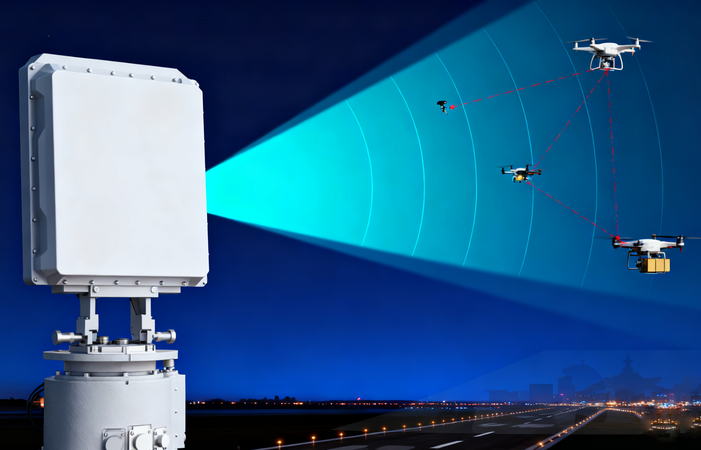
Most detection radars used in anti-drone applications adopt X-band or Ku-band technology. These radar waves have strong penetration and are not affected by rain, 눈, 안개, or nighttime darkness, allowing stable operation even in harsh weather. 추가적으로, radars feature 360° horizontal scanning, combined with a certain angle of pitch detection (예를 들어, 30°), forming a three-dimensional monitoring network. Whether it is a small drone flying close to the ground or a device cruising at high altitudes, none can escape its “sight,” completely eliminating monitoring dead angles.
2. Long-Distance Detection + Accurate Tracking—Locking in “Unauthorized Flight” Paths in Advance
Tailored to anti-drone scenarios, professional detection radars typically have a detection range of over 4 킬로미터, with some high-performance models capable of even longer distances. This means that as soon as an unauthorized drone enters the edge of a controlled area, the radar can detect it immediately. More importantly, radars not only “see” targets but also accurately track their movement—whether it is a high-speed racing drone, a low-speed aerial photography drone, or a hovering device. Radars can capture real-time data such as position, 속도, 고도, and even continuously track complex flight paths (예를 들어, drone circling or turning back) through dynamic data updates, buying ample time for subsequent response.
3. Rapid Threat Identification—Linking to Anti-Drone Systems for “One-Click Disposal”
After detecting and tracking a drone, detection radars can also assess the target’s threat level in real time based on preset rules. 예를 들어, drones entering airport clearance zones or military restricted areas are classified as high-threat targets, while those flying legally over ordinary parks are low-threat. Once a high-threat target is identified, the radar can directly connect to anti-drone disposal systems (such as drone jammers or net launchers) via standard interfaces, enabling fully automated “detection-tracking-assessment-disposal” processes with minimal human intervention, significantly improving anti-drone response efficiency.
Detection Radars Are Silently “Guarding” These Scenarios
In the anti-drone industry, detection radars have long been integrated into key scenarios, serving as core equipment for ensuring low-altitude security:
1. 공항: “Mine Sweeping” for Flight Takeoffs and Landings
Airport clearance zones are high-risk areas for unauthorized drone flights. Even a small drone could collide with an aircraft, causing a serious accident. 그러므로, nearly all airports have deployed detection radars. With a detection range of over 4 킬로미터, these radars cover the controlled areas around airports. Upon detecting an approaching drone, the radar immediately issues an alert and links to airport security to activate jamming measures, ensuring the safety of flight takeoffs and landings.
2. Critical Facilities: Building a Security “Firewall”
Military bases, 정부 건물, 원자력 발전소, and oil refineries have extremely high requirements for low-altitude security, with no room for negligence. Here, detection radars provide 24/7 uninterrupted monitoring of surrounding low-altitude airspace, preventing drones from conducting surveillance or delivering suspicious items. 예를 들어, radars around nuclear power plants can penetrate complex terrain and harsh weather to monitor low-altitude dynamics in real time, detecting “uninvited guests” even in heavy rain or fog.
3. 대규모 이벤트: Protecting Crowded Areas
At large-scale events such as concerts, sports competitions, and National Day celebrations, crowds are dense. Unauthorized drones entering the area could not only leak event information but also cause injuries if they crash out of control. In such cases, detection radars are deployed around the event venue to form a circular monitoring zone. Upon detecting an illegal drone, they immediately link to ground jamming equipment to quickly force the drone to land or drive it away, avoiding accidents.
4. Border Areas: Preventing Illegal Cross-Border Activities
Border regions have complex terrain, and some criminals may use drones for smuggling or delivering contraband. Leveraging their long-distance detection and all-weather operation advantages, detection radars can cover low-altitude areas around borders, monitoring in real time for drones crossing the border illegally. Upon detecting anomalies, they can link to border defense forces for timely disposal, safeguarding border security.
The Future of Anti-Drone Radars: Smarter and More Flexible
As drone technology advances, methods of unauthorized flight are also evolving—for example, smaller and more concealed micro-drones, and even “bionic drones” that simulate bird flight. To address these new challenges, detection radars continue to evolve: future anti-drone radars will be smarter, integrating AI algorithms to more accurately identify drone models and distinguish between “legal flights” 그리고 “unauthorized flights.” 그 동안에, equipment will become more lightweight and portable, supporting not only fixed deployment but also vehicle-mounted and handheld scenarios to meet temporary control needs (such as temporary large-scale events or emergency security tasks).
In summary, in the anti-drone industry, detection radars are like a pair of “tireless eagle eyes,” using technology to safeguard our low-altitude security. Whether at airports for daily travel or at critical facilities, they work silently to eliminate unauthorized flight risks in their early stages, making the sky above us safer and more orderly.